Posts

Showing posts with the label Greater Peoria Airport Authority

PIA - A History: Events of 2002 (Includes Video Slideshow)

Image
In 2002, the Greater Peoria Regional Airport regained its status as Central Illinois' busiest air passenger facility. That was the good news, but the storm clouds of uncertainty, continuing security concerns and turmoil in the airline industry continued to plague the outlook for local airline service. Let's review airline service changes which occurred that year.  AMERICAN CONNECTION (Trans States Airlines) At the start of 2002, this carrier offered seven weekday departures to St. Louis. Traffic was recovering post-9/11, so it resumed an eighth on January 8. April schedules show a ninth had been added, though newspaper coverage in late-June indicates service had been reduced to seven again. Frequency was brought back up to nine roundtrips on September 4. These flights operated with a mix of 68-seat ATR-72, 48-seat ATR-42 and 29-seat Jetstream 41 turboprops.  AMERICAN EAGLE (American Eagle Airlines) When 2002 began, weekday departures to Chicago-O'Hare totaled four. Passenge...
PIA - A History: Trying to Turn it Around (1995-1996)

Image
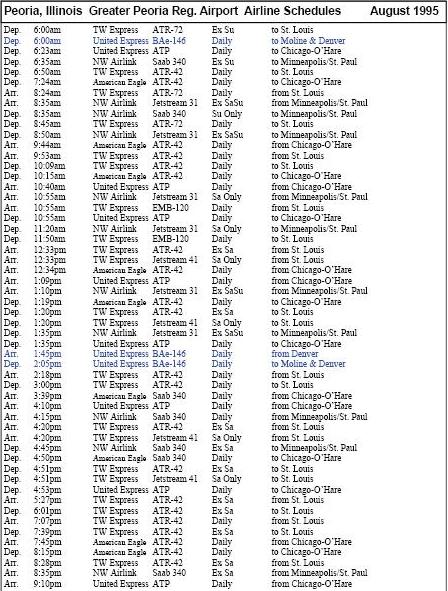
By 1995, it was clear that PIA's passenger business was in recession. One would expect a downward trend during an economic recession, but at this time both the local and national economy were booming. High fares, loss of major carriers and the false perception created by the local media that PIA had lost all jet service were primary contributors to the decline. Understanding the times is vital. Let's start with a rundown of local air service happenings in 1995 and 1996. AMERICAN EAGLE (Flagship Airlines/Simmons Airlines) When a sufficient number of Flagship Airlines Saab 340 turboprops were made available and their crews finished training for winter weather operations, Chicago-O'Hare service resumed Janauary 4, 1995. Initially, there were six daily roundtrips. The FAA's December 9, 1994 order to ground ATR-42s apparently ended permanently the Peoria-Burlington (Iowa) tag-on that was operated daily for several years. Simmons returned its ATR-42 fleet to five of s...

PIA - A History: Events of 1984

Image
Peoria's economy remained in the dumps in 1984 as Caterpillar continued to shed employees as well as facilities. But airport passenger traffic continued to rise. An April 15 article proclaimed a nine percent increase and that fares were competitive with Chicago and St. Louis. Britt Airways' service remained largely unchanged with FH-227s operating eight roundtrips between Peoria and Chicago-O'Hare with seven nonstops to and eight nonstops from that facility. Bloomington-Normal and Springfield tag-ons gave the Terre Haute, Indiana-based airline a total of eleven weekday departures. A January 5, 1984 newspaper ad touted connections to American Airlines' Chicago-O'Hare hub. Mississippi Valley Airlines provided five weekday flights to O'Hare and six from, while Burlington (Iowa) and Springfield (IL) tag-ons provided a total of eleven weekday departures. The Moline, Illinois-based airline used a mix of Fokker F-27s, Shorts 360s and Shorts 330s. MVA newspaper ads...

PIA - A History: Events of 1983

Image
Events involving PIA continued their rapid pace during 1983.  The year began with the area's largest employer, Caterpillar Tractor Co., on strike. Begun October 1, 1982, it lasted nearly 30 weeks until April 24, 1983. Although the strike had ended, the company continued to suffer declining engine and machine sales. Additional layoffs were announced shortly and people telling each other, "Will the last person leaving Peoria please turn out the lights?" And yet, passenger traffic at the Greater Peoria Airport began to grow again. Perhaps it was more a reflection of the national economy, which began showing signs of life in late 1982. Recovery continued into 1983 as inflation slowed, fuel prices declined and reduced tax rates helped fuel consumer spending and business investment. Some cite the end of fare wars that prompted travelers to drive to Chicago or St. Louis instead of flying out of Peoria.  Because Ozark had significantly reduced service at Peoria in 1981...

PIA - A History: New Destinations and a Second Airline, 1974-1977

Image
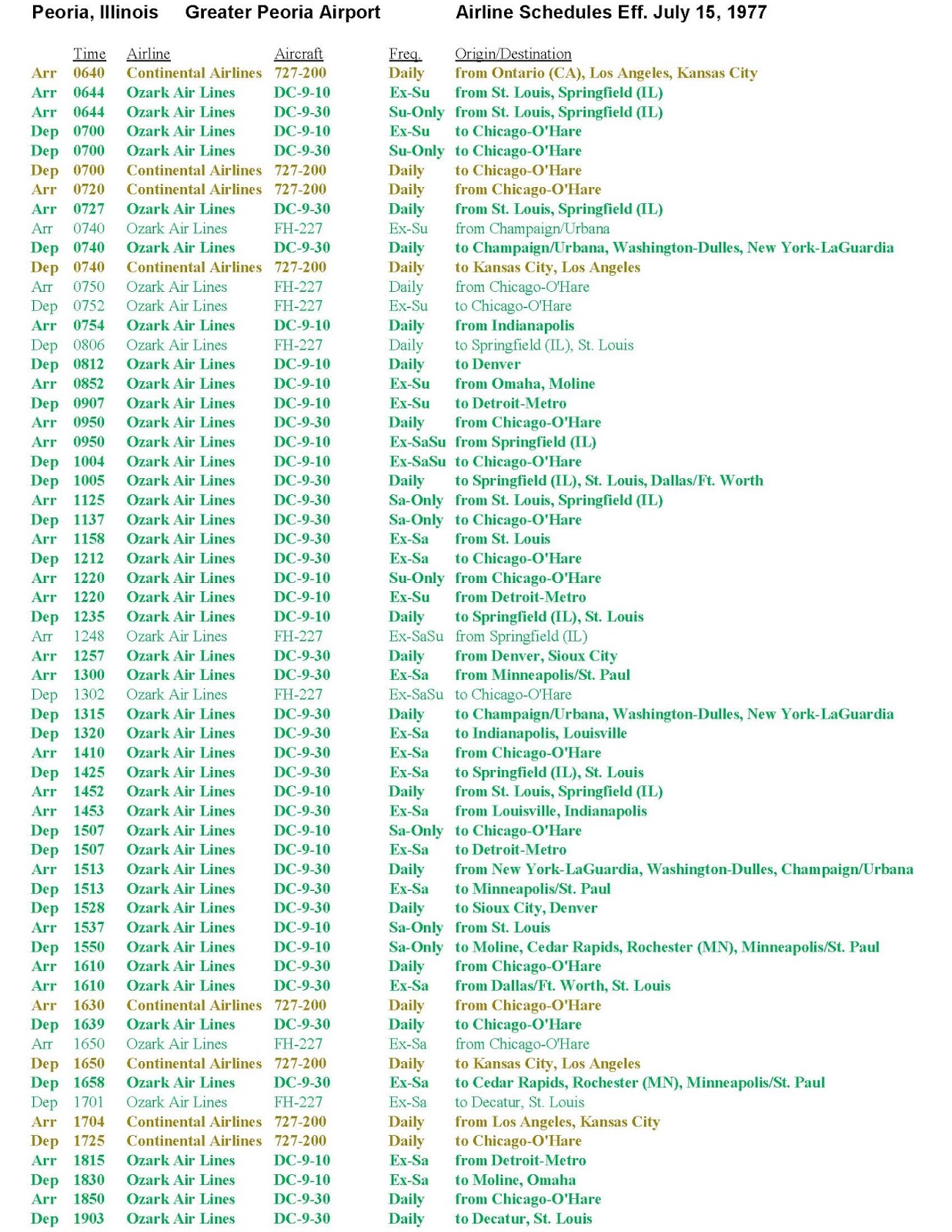
Having avoided the worst effects of the mid-1970s recession, Peoria was considered a "prosperity pocket." Major area employers like Caterpillar, Bemis, Hyster, Keystone Steel & Wire, Pabst, WABCO) actually posted record sales in 1974. Caterpillar sales grew another 21.6 percent in 1975 and the company employed 33,600 in the area at the start of the year. Some 8,000 had been added to the payroll since 1965 (mostly since 1971) and was expecting to add up to 9,000 more, mostly by 1980. So the local economy was good when Ozark Air Lines decided to expand its Peoria service offerings.  NEED FOR AN O'HARE ALTERNATIVE After the last flights shifted from Midway Airport in mid-1962, Chicago-O'Hare International Airport became the world's busiest. Since then, Peoria travelers had relied on O'Hare for most domestic and international connections, but increasing congestion from rapidly growing traffic prompted the Federal Aviation Administration (FAA) in 1969 to...

PIA - A History: Crisis and Frustration (1973)

Image
Airport safety and security was the issue as 1973 dawned.  The Greater Peoria Airport began screening passengers on January 5. Use of a metal detector began in February. Understandably, Ozark Air Lines objected to a new security tax proposed by the Nixon Administration, which the airline claimed would penalize short-haul air travel. In Spring 1973, Airport Surveillance Radar  (ASR) was placed into service just west of the airfield, enhancing safety. Its continuous scan radius encompassed 40 miles and up to 10,000 feet.  The Greater Peoria Airport had every reason for optimism. The facility handled 300,000 passengers for the first time in 1972 and traffic was expected to rise rapidly through the decade. Then the disadvantages of being serviced by only one airline reared its ugly head. THE OZARK STRIKE Members of the Aircraft Mechanics Fraternal Assocation (AMFA) struck Ozark Air Lines on April 19, forcing the carrier to suspend all scheduled operations. Among ...

PIA - A History: M. A. T. S. Airlines and Events of 1972

Image
NINETEEN SEVENTY-TWO marked a decade since Peoria was a Trunk Airline stop. Although Ozark Air Lines offered expanded service in recent years, the Greater Peoria Airport Authority (GPAA) began sniffing around for an additional carrier. Meanwhile, Peoria was about to witness the birth of a second, locally-based commuter airline. M. A. T. S. AIRLINES In December 1971, Chicago & Southern Airlines president Richard Willard detailed plans for a new commuter airline to link Peoria with downtown Chicago (Meigs Field), Davenport, Detroit, East St. Louis (Bi-State Parks) Gary, Indianapolis and Minneapolis/St. Paul. Initially, it was to be called "Central Illinois Airline" and operate De Havilland DH-114 Herons . Eventually, remanufacturered Herons, called Saunders ST-27s, would be acquired by the new airline, a division of Peoria-based Manufacturers Air Transport Service (C&SA and MATS had stockholders in common). Willard was named division's vice-president and gen...

PIA - A History: Jets and Air Taxis, 1966-1967

Image
In the last post in this series, we looked at Ozark Air Lines' growth at Peoria and the prospect for jet service. In December 1965, DeWitt Collins announced his retirement as airport director, a position in which he had served since 1948. His successor, Thomas Schepke, serving as assistant director since 1950, assumed the director's job in March 1966. Ron Burling was hired in May to assist Schepke.  Among Schepke's duties was to prepare for the inauguration of PIA's first turbojet service on Ozark Air Lines' DC-9s and help manage airport expansion. Extension of Runway 4-22 by 1,000 feet to the northeast required closure of Airport Road north of its intersection with Harmon Highway. A 525 foot southwest extension was planned, giving the runway 5,202 feet. Eventually, this was increased to 5,700 feet by adding 600 feet to the northeast extension, and cutting the southwest extension to 500 feet. Initial GPAA approval for the project came in late-December 1966....